
Editorial Note
Links to other media and further information regarding this topic can be found in the German version of this article.
1. Terminology
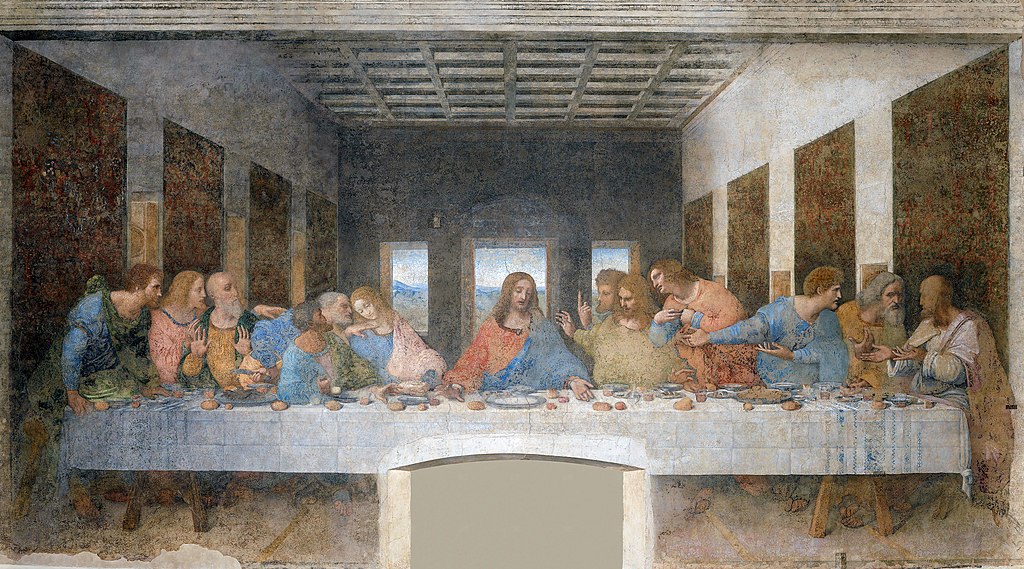
“The Last Supper” (Abendmahl) is a common term used for the central rite of worship that is performed in most Christian denominations with bread and wine. Other common terms are “Eucharist” (Eucharistie) or “the Lord’s Supper” (Herrenmahl). The rite commemorates Jesus’ final meal with his disciples that, according to the synoptic gospels at least, he celebrated on the Thursday before his execution. Within the Church, it is generally considered a sacrament, i.e., a rite that symbolically conveys to believers the salvation founded in the life and death of Jesus Christ. It is a distinct sacrament (the number of which differ in the various denominations) and also differs from the Agape meal (i.e., the general meal of love in which the congregation remembers Christ through the breaking of bread, thereby symbolically forming itself as a community).

2. Biblical Foundations
The biblical accounts concentrate on anchoring the rite historically in the story of Jesus’ Passion and in Jesus’ interpretative words concerning the elements of bread and wine [“words of institution” (Einsetzungsworte): Mt 26:26–29; Mk 14:22–25; Lk 22:15–20; 1 Cor 11:23–26]. These accounts clearly reflect the communal practice of the early Christians while also making this practice normative. The actual phrasing of the words of institution varies between Matthew and Mark on the one hand and Luke and Paul on the other, especially with regard to Jesus’ identification of the cup as the “blood of the covenant” (Mt / Mk) or as the “covenant in my blood” (Lk / 1 Cor). In addition, Luke and Paul provide a direct invitation to imitate Jesus’ last supper “in remembrance of me,” something that is missing in Matthew and Mark. Written in Syria in the early second century, the Didache suggests that there was still a high degree of variability in how the rite was celebrated in this early period.
The affinity to the Jewish Passover meal as well as the biblical designation of Jesus as the Passover lamb (1 Corinthians 5:7) suggest that the rite of the Lord’s Supper was an early Christian reworking of the Passover. Originating as an intra-Jewish movement that formalized the rite in the Aramaic-speaking context of Palestine [indicated by the call “Maranatha” (Didache 10:14)], the early Christian community used it to re-semanticize the Passover, thereby ultimately contributing to the idea that Christianity supersedes Judaism. This theory of supersessionism was established in the early period of Christianity when the expectation of a relatively immanent eschaton dominated. In this respect, we can understand the early reports as a form of remembrance that makes present what is remembered and, at the same time, a prolepsis of the future. The agency in the event primarily comes from the side of the congregation, which both remembers and looks ahead.
3. Historical Diversification
Among the early interpretations added to the biblical accounts is an interpretation of the Last Supper as a sacrifice that heightens the other already prevalent meanings. This sacrificial interpretation is present in the writings of Ignatius of Antioch 
 (2nd century) and is associated with the strong soteriological emphasis in the Syrian bishop’s writings. In his reference to “spiritual food” (1 Corinthians 10:3f.), Paul also hints at a possible salvific effect of eating that goes beyond a mere act of remembrance and a mere symbolic process of making-present. What Paul hints at becomes clearer in Ignatius’s writings: here the Eucharist is “the medicine of immortality,” “the antidote preventing death” (φάρμακον ἀθανασίας / pharmakon athanasias; IgnEph 20,2).1Schoedel, William R., Ignatius of Antioch. A Commentary on the Letters of Ignatius of Antioch, Philadelphia 1985, 121. The dynamic of remembrance – and sacrifice – that defines the congregation’s act of worship is thus met by God’s act of coming to the congregation. Questions about the way in which God is connected to the event or makes Godself present become unavoidable at this stage. In the course of the divergence between the Eastern and Western churches, the liturgy and theology of the former came to emphasize strongly the pneumatological dimension of the Eucharist: the Spirit brings about the actual presence of God that is located primarily in the gift of the elements. Debates about the ontological mode of this presence did not play the same role as they did in Western Latin theology where they eventually led to numerous divisions.
Western theology received a double heritage. On the one hand, it emphasized – as in all sacraments – the symbolic nature of the Eucharist. Crucial here was Augustine’s distinction betweensignum (sign) andres (substance), which can be either sharply distinguished or closely intertwined. On the other hand, Gregory the Great handed down to the Middle Ages a heavy emphasis on God’s becoming present in the elements, especially the bread. In the First Communion Controversy of the 9th century, Ratramnus and Paschasius Radbertus debated the differences between these two accentuations. They ultimately reached no final resolution. However, with the Second Eucharist Controversy in the 11th century, the idea of an ontologically definable presence of Christ bound to the elements became decisive for the Latin West. The monk Berengar offered an analysis of this idea using Aristotelian ontology. He determined that it was philosophically inconceivable that the accidents – the outwardly perceptible properties of bread and wine – could persist while the substance was transformed into the body of Christ. Under trial, however, Berengar was forced to confess precisely this mode of presence, at least up until the point when the body of Christ was ground up by the recipient’s teeth.2Cf. Ego Berengarius (DH 690) [Kompendium der Glaubensbekenntnisse und kirchlichen Lehrentscheidungen (= Enchiridion symbolorum definitionum et declarationum de rebus fidei et morum), verbessert, erweitert, ins Deutsche übertragen und unter Mitarbeit von Helmut Hoping hrsg. von Peter Hünermann, Freiburg i. Br. 452017]. The dispute during this same period between the papacy and the Greek Orthodox Church concerned something different: the West continued to use unleavened bread for the host – thus making clear the connection to the Passover ritual – while the East used normal bread. This was one point of contention that eventually led to the schism between East and West in 1054.
The debates that ensued in Western theology increasingly focused on the question of how to conceive of the presence of Christ in the Eucharist. Berengar’s analysis indirectly led to the use of an Aristotelian concept in the dogmatic definition that we find in the Fourth Lateran Council of 1215: the body and blood of Christ are present “under the changed (transsubstantiatis) forms of bread and wine.”3DH 802, translation by Dylan S. Belton. Thomas Aquinas subsequently fleshed out this teaching on the transformation of the substances of bread and wine into the body and blood of Christ.
As an official Catholic doctrine, the teaching on transubstantiation formed part of the context that the reformers reacted against. Martin Luther considered it inappropriate to make philosophy part of Christian dogma. He insisted on the original intent of the statement that the presence of Christ is bound to the elements – “in, with, and under” the elements, as the later Lutheran doctrine stated it.4Cf. FC.SD VII: “‘unter dem Brot,’ ‘mit dem Brot,’ ‘im Brot’” (BSELK 1,1468,22). Luther refused to explain this using the Aristotelian substance-accident scheme. He instead deployed the Christological teaching according to which the divine property of omnipresence was transferred to the human nature of Christ (cf. art. Doctrine of Christ’s Two Natures) such that the body of Christ is wherever it wants to be (doctrine of ubiquity). The Zurich reformer Ulrich Zwingli disagreed with this explanation. He interpreted the Lord’s Supper exclusively as a symbolic and memorial meal, with the congregation – not God – as the protagonist of the event. His theology was overshadowed by that of John Calvin , who interpreted the entire event as a spiritual one. According to Calvin, the presence of Christ in the context of the celebration emerges from the fact that, on the one hand, the congregation rises up to God through the Holy Spirit and, on the other hand, the Holy Spirit descends to the congregation. Calvin established the Reformed churches’ understanding of the Last Supper that, alongside Orthodoxy, Catholicism, and Lutheranism, represents a forth type of interpretation. It subsequently influenced many of the independentchurches (Freikirchen). The Reformed and Lutheran teachings have now largely converged, particularly as a result of the Leuenberg Agreement of 1973 (see below).
4. Theological Problems and Tasks
Due to this complex historical development, the Last Supper has become a dividing factor among certain denominations, the significance of which is immense due to its status as a sacrament. This denominational context places certain limitations upon individual theologies. In this regard, systematic theology is more so a confessional theology than it is a constructive achievement of an individual. Even Friedrich Daniel Ernst Schleiermacher’s attempt to formulate an account of the Last Supper that transcends the denominational camps within the Protestant Church remains bound precisely to these denominational regulations. For this reason, the problems discussed below must be understood primarily on the basis of the denominational differences and the historical factors from which they have emerged.
4.1. Agencies (Geschehensdynamiken)
We can better understand the complex theological differences in these interpretations of the Last Supper if we view them as expressing different conceptions concerning the agencies involved in the event. The accounts of the words of institution found in the gospels suggest that the agency lies on the side of the celebrants. That is, the latter follow Christ’s instruction to celebrate his memory with the help of symbolically meaningful objects that make him present in a symbolic way. In the history of theology, Zwingli gave voice to this dynamic particularly clearly. Martin Luther adopts the radically opposite position. According to Luther’s interpretation, God is the only agent in the event and permeates the elements in such a way that they have a salvific effect. The other three types of interpretations tend to adopt positions that, each in their own way, describe the agencies of God and the congregation in a reciprocal manner. Roman Catholic doctrine focuses on the priest who performs the Eucharistic sacrifice on behalf of the congregation as well as Christ. God makes Godself present, and it is precisely this self-presenting God that the congregation offers up in the sacrifice. For both the Orthodox and the Reformed Churches, human and divine agencies converge in the action of the Spirit who is present as a divine person in believers.
4.2. Soteriology
Since the 2nd century at the latest, the rite of the Last Supper has been associated with the idea of a sacrifice that re-enacts the crucifixion on Golgotha. This notion has been questioned in various ways. It presupposes that Jesus’ death is also understood as a sacrifice for which there is ample biblical evidence.
Toward the end of the 20th century, theologians began increasingly raising questions concerning the aspect of cruelty entailed in the notion of a God who sacrifices God’s own Son. It is not easy to reconcile this cruelty with the biblical image of God. The notion of sacrifice has been critiqued by means of an emphasis on God’s love.5See in particular Grümbel, Ute, Abendmahl. „Für Euch gegeben?“ Erfahrungen und Ansichten von Frauen und Männern. Anfragen an Theologie und Kirche, Stuttgart 1997.
In addition, even if we understand the event of the cross as a sacrifice, the interpretation of the Eucharist as a sacrifice is still problematic in several respects. It was criticized by the Reformers insofar as it assumes an agency on the part of the celebrants that contradicts the doctrine of justification by grace and through faith alone. However, this criticism only applies to a model according to which the Eucharist involves a separate sacrifice alongside or after the sacrifice on Golgotha. Yet even in Thomas Aquinas’s writings it is clear that the Eucharist is not a separate, new sacrifice that, as the Reformers suggested, would undermine the ἐφάπαξ / ephhapax (Heb 9:12), the unique sacrifice of Jesus Christ (cf. art. Death of Jesus Christ). According to Aquinas, the Eucharist is more so a reenactment of the unique sacrifice of Jesus himself, a new becoming-present of the latter that makes the effectiveness of the event of the cross (cf. art. Crucifixion) fruitful for the celebrating congregation. So understood, this account of sacrifice simply expresses a variant of the view shared by those denominations that see in the Lord’s Supper an action from God’s side and that also see it as a sacramental event in which the salvation established on the cross is reappropriated by those who are spatially and temporally separated from this original event. In this sense, the Last Supper is part of the process through which God justifies and sanctifies believers. This does not exclude other – even entirely free – forms of God’s conferring grace, but it does mean that God binds Godself to the promise of salvation in the form of the Eucharist. Believers can therefore rely on finding salvation and justification there. This is the reason for the strict ritual regulation of the rite, in contrast to the much freer form of the Agape meal. The legitimate appropriation of this salvation through the Eucharist depends upon the recitation of the words of institution as God intended them. Saying the literal so-called words of institution over the bread and wine – or using a combination of other biblical quotations – is crucial for the vast majority of Last Supper rites and is of particular importance here.
4.3. Forms of the Personal Presence of Christ
The general question concerning the representation of the event on Golgotha culminates once again with the problem of the personal presence of Christ. When looking at the history of Christianity, it is possible to recognize two main approaches to this problem: a more pneumatological approach, which teaches a real presence of Christ in the Holy Spirit, and a more ontological approach, which links the real presence of Christ to the elements of bread and wine in which the body and blood of Christ are fully present. The relevant biblical passages are here again the words of institution. In the history of Christian interpretation of these passages (which we may assume represent the original Christian context), the first approach sees in them a symbolic actualization of a historical event. The ontological interpretation emerges later, but it became decisive for mainstream Latin theology. The doctrine of transubstantiation formulated philosophically the notion of the real presence: while the external accidental properties of the bread and wine remain unchanged, the substance underneath is transformed into the substance of the body and blood of Christ. This same philosophical framework is also operative in the alternatives to transubstantiation that the Catholic Church rejected – namely, annihilation (destruction of the substances of the elements and their replacement by Christ’s body and blood), consubstantiation (addition of the substance of the body and blood of Christ), and Martin Luther’s insistence on the bodily presence of Christ. For both Roman Catholic and Lutheran doctrine, this idea of a bodily presence of Christ linked to the elements has remained central, despite all the differences in interpretation. These positions assume that this presence is the result of the correct use of the words of institution, regardless of the individual faith disposition of the priest or the recipient. According to Roman Catholic teaching, Christ is made present at the moment of consecration and remains present in the elements even after communion has been administered. The elements – especially the bread kept in a designated place (tabernacle) – remain permanent bodily presences of Christ. According to the Lutheran view, Christ’s bodily presence is bound to the Last Supper event only within the context of the liturgy and does not continue beyond this. After the Last Supper, the bread becomes, theologically speaking, simple bread again.
We find an interpretation focused on the Spirit in the Orthodox doctrine of the Eucharist. The background conceptual framework that guides this understanding of Christ’s presence is a Platonic archetype-image model, one that also informs Orthodoxy’s theology of the image. Here the image – the Eucharist – is related to its archetype – the body and blood of Christ – not only in a symbolic way but also in a process of real participation. That is, the image represents what is depicted while also becoming it as a result of a transformation (μεταβολή / metabole) that actually takes place in the course of the celebration.
In contrast to the Orthodox teaching, the Spirit-oriented explanation of John Calvin and the Reformed doctrines that followed it denied an ontological real presence in the elements. The Spirit-induced faith of the recipients is co-constitutive of the presence of Christ – that is, where his presence is not accepted in faith, he is offered but is not in fact present. Conversely, the work of the Spirit in the Lord’s Supper gives rise to a spiritual real presence: “It seems fair to say that Calvin agreed in principle with Aquinas and Luther on the fact of real and objective presence, but disagreed with them about the modes of presence and reception.“6Hunsinger, George, The Eucharist and Ecumenism. Let Us Keep the Feast, Cambridge 2008, 38. Recognizing this made it possible to overcome confessional differences, as the example of the Leuenberg Agreement of 1973 shows. Here a large number of Protestant churches came together and confessed:
In the Lord’s Supper, the risen Jesus Christ gives himself in his body and blood, given for all, through his promising word with bread and wine. He thereby grants us forgiveness of sins and liberates us to a new life through faith. He lets us experience anew that we are members of his body. He strengthens us for service to others.7https://www.ekd.de/Leuenberger-Konkordie-II-Das-gemeinsame-Verstandnis-des-Evangeliums-11307.htm, accessed on 18.11.2025, translation by Dylan S. Belton.
With the paper “Together at the Lord’s Table,” the Ecumenical Working Group of Protestant and Catholic theologians developed approaches for facilitating further dialogue between the Roman Catholic, Lutheran, and Reformed churches. They place particular emphasis on the significance of the invitation to the Lord’s Supper by Jesus Christ himself, an invitation that transcends all human limitations.
None of the ways of describing Christ’s presence in the Last Supper can avoid the necessity of precisely defining in semiotic terms the relationship between, on the one hand, the elements and the Last Supper event and, on the other hand, the elements and Jesus Christ. Even if the presence of Christ is ontologically bound to the elements, the latter retain a sign function according to which – following Augustine – they are related as signum to the res of the grace given in Christ. The most obvious reference to semiotics in the words of institution is in the command “Do this in remembrance of me” that is found in Luke and Paul. Only Ulrich Zwingli interpreted this as a purely human process of remembering, while all other interpretations in one way or another assume a correlation between human remembering and a divine spiritual act. In Reformed thought, this correlation is constitutive of the presence of Christ, while in Roman Catholic or Lutheran thought it is linked to the ontological presence. However, the sign-function and the presence-function can diverge. While the bread obviously signifies Christ’s body and the wine his blood (according to the words of institution), the doctrine of concomitance that emerged in the 12th century states that, ontologically speaking, the body and blood of Christ are present simultaneously in each of the elements. This applies in particular to the bread that – according to the customary Roman Catholic rite – contains the body and blood of Christ and whose reception can therefore count as full communion, even if the congregation is not given the cup with the wine.
4.4. Congregation and Ministry
Although the proclamation of the Gospel is entrusted to all Christians at baptism, the specific communication of God’s gifts of grace through word and sacrament is, according to most traditional denominations, bound to specific ministerial guidelines. According to the Lutheran explanation, only ordained persons are authorized to publicly proclaim the word and administer the sacraments, both of which are the fundamental characteristics of the Church. The reason for this is, on the one hand, that it is an institution-related (in the early modern sense of public) act and, on the other hand, that the bestowal of grace can only take place from the outside and therefore requires uniquely authorized persons. Within the Roman Catholic Church, the conditions that justify a legitimate ordination / consecration (Ordination/ Weihe) are not only anchored in this process itself and its biblical rationale but also in the chain of tradition (the so-called succession of ministries), which the Church hierarchy traces back to Jesus’ calling of the apostles. This entails a close relationship between the Eucharist and the Church in Roman Catholic thought.
It is probably no coincidence that, when it comes to the Last Supper, the denominational communities that adhere to some form of ontological presence also attach particularly strong significance to the ordained ministry. Since the early Church, ideas about how to deal with the sacred / divine – and the basic conditions that are required for it – have also played a role here. This emphasis on the minister does not necessarily preclude a strong emphasis on the congregation. Since the early Middle Ages, the relationship between the real body of Christ (corpus Christi reale), the Eucharist, and the mystical body of Christ (corpus Christi mysticum) – as the Christian community is characterized in 1 Corinthians 12 – has been emphasized. However, going beyond this framework so as to ground God’s presence in the Last Supper in the spirit of the believers can bring the event closer to other forms of God’s presence that are less bound to rituals. Accordingly, the role of the ordained minister in a predominantly Spirit-oriented interpretation of the rite is theologically less significant than in other interpretations. In the former, more attention is given to the community-building aspect of the rite where congregants gather together in a spiritual event.
5. Considerations from cultural-studies
The theological explanations of the Last Supper described above need to be reflected upon anew in light of contemporary approaches emerging from cultural studies. In some cases, this can lead to reformulations, but it can also give rise in other cases to a critical questioning of classical concepts. The latter possibility certainly applies to the Pauline-Augustinian anthropology that is strongly committed to the idea of the human as a sinner and that influences the classical understanding of the Last Supper. To a certain extent, this anthropology corresponds with Arnold Gehlen’s definition of the human as a deficient being (Mängelwesen).8Cf. Gehlen, Arnold, Der Mensch. Seine Natur und seine Stellung in der Welt, ed. Karl-Siegbert Rehberg, Frankfurt a. M. 2016. However, the question is whether the concept of sin enriches our understanding of this deficiency or whether it perhaps obscures it by interpreting it as demeaning.
Other anthropological insights stemming from the human sciences are more conducive to deepening our understanding of the Last Supper. As a meal, the latter involves elementary eating processes that have a double relevance. One obvious consideration here is the social function of communal meals. Paul’s account of the words of institution in 1 Corinthians 11 suggests that the Lord’s Supper was originally practiced as a unique kind of communal meal that was distinct from meals connected to pagan sacrifice in which sacrificial meat was eaten. The fact that the ritualized part of the Lord’s Supper eventually separated itself off and became a component of a liturgy (instead of a communal meal) meant that the rite’s social function receded into the background. One of the tasks of eucharistic theology (in connection to the aforementioned Agape meal) is to regain this social dimension. Eating as an act of incorporation creates an intimacy between persons of the greatest possible bodily intensity, comparable only to the sexual act (with the difference, of course, that the latter entails a direct encounter between two people, whereas the personhood of Christ in the Lord’s Supper is hidden under the symbolic elements of bread and wine). From an anthropological perspective, the eating metaphor thus raises the complex theological questions about God’s mode of presence as discussed earlier, especially if one wants to avoid the inadequate analogy to cannibalism. At the same time, it makes clear that physical events (i.e., food) and spiritual events (i.e., an encounter with God) are inextricably intertwined in the Eucharist.
Cultural-sociological research on the anthropological significance of the gift and its reception also provides new plausible ways for understanding God’s action.9Cf. Mauss, Marcel, Die Gabe. Form und Funktion des Austauschs in archaischen Gesellschaften, Frankfurt a. M. 1990. In both the more reciprocal models found in Catholicism and the Reformed Churches as well as the Lutheran model (which focuses strictly on God’s action), God’s action could be understood as a “gift” that creates its own reality in its recipients.10For an exemplary recent discussion, see Miesner, Anje Caroline, Sich geben lassen. Das Abendmahl als wirkmächtiges Ereignis, Tübingen 2020. Conceptions of ministry and the congregation also need to be rethought from a sociological perspective, and, when necessary, reformulated. With the increasing dissolution of the Sunday congregation, the Lord’s Supper is fast becoming a rite for individual specialists who are familiar with its meaning. This is reinforced by practices that are increasingly perceived as mechanisms of exclusion. It is relatively easy to eliminate the exclusion of people suffering from alcoholism, for example, by replacing the wine with an equivalent (e.g., grape juice). More important is the question concerning what degree of cognitive awareness is required for participation in the rite, i.e., how participation can be opened up to young children, people with learning difficulties, or people with dementia. An inclusive response to this question must be based on a pre-cognitive understanding of faith, something that is already operative in those denominations that practice infant baptism. While the tendency toward more inclusivity is usually the guiding principle here, it is still debatable whether non-baptized people should be included. This question is pressing in light of the increasing interweaving of different religious-social milieus. However, from a dogmatic perspective, it remains the case that the encounter with Jesus Christ in the Last Supper can only be salvific if it takes place with faith in Jesus as the redeemer and the Son of God.
Looking at social location raises questions regarding other ways of celebrating the Lord’s Supper. The Covid crisis in particular has produced models that make the separation of the celebration from Sunday services a real possibility. As an enactment of the general priesthood of believers, home communion was newly reinstated as a form of celebration in a small private circle without the participation of ministers. The notion of a digital Last Supper even involves the participation of a congregation whose members are spatially dispersed but still connected by the Spirit. The debates pertaining to this latter possibility11Cf. Reimann, Ralf Peter/Leppin, Volker, pro und contra: Ist digitales Abendmahl sinnvoll?, (https://zeitzeichen.net/node/8326), accessed on 18.11.2025. indicate (from both those who are for and against it) that, in addition to the acute crisis, a sociological development that has been noticed for some time has now become clear – namely, that, in the faith life even of committed Christians, the communal dimension has become more prominent in comparison to the presence of Christ within the elements.12Cf. Rambusch-Nowak, Martina, „Nehmet hin…“. Erinnerung an die Zukunft. Gemeindetheologische Erwägungen zum Abendmahl, in: Müller, Wolfgang Erich/Konukiewitz, Enno (Ed.), Abendmahl heute. Reflexionen zur theologischen Grundlegung und zeitgemäßen Gestaltung, Frankfurt a. M. 2002, 69–94, 80f; Grümbel, Abendmahl, 302–363. This stands in clear tension with the idea of the Lord’s Supper as a gift from God. If this emphasis on the communal dimension is to be preserved as a special characteristic of the rite, it should be asked whether Agape meals may be offered more frequently as a place of celebration and may be seen as the foundation of the community. Much more than the traditional celebration of the rite, these meals could emphasize the entire congregation’s priestly role that is not necessarily tied to the official office of the priesthood. The fundamentally confessional character of eucharistic theology noted above is also evident in these debates. On the one hand, it is dissatisfying that constructive work within systematic theology concerning the Lord’s Supper always has to be measured against normative denominational standards. This entails the aforementioned problem of exclusion and also the use of what are possibly outdated ontological presuppositions. On the other hand, however, it is precisely this requirement that shows that the Lord’s Supper is an act of Christian faith that precedes individual deliberation. It is fellowship among Christians and with God that is enacted in the Lord’s Supper – and this always requires an account of the conditions that enable this fellowship. For future eucharistic theology, it might be liberating to develop further the dialectical relationship between the Eucharist and the Agape meal. The latter has important aspects in common with the former (especially the communal aspect), but it also allows for a wider scope of theological, ritual, and social organization. It may therefore give expression to the desire for community and social openness. The Lord’s Supper, on the other hand, can retain its unique status insofar as it represents a clearly defined event that is closely associated with the promise of the sacramental gift of grace.