
Editorial Note
Links to other media and further information regarding this topic can be found in the German version of this article.
1. Introduction
“Hell” in Christian theology refers to the underworld in a general sense, the realm of the dead, or a post-mortem place of purification and / or punishment. Hell is mentioned in the Apostles’ Creed in the sense of the underworld from which Christ saves, but in Western theology it is generally understood as place of everlasting punishment. In essence, the doctrine of hell centers on the issue of justice being done to perpetrators and victims. Related questions are the extent of the atonement, the role of the devil, and the relation between God’s love, proportionality, and punishment.
2. Scripture
The Bible provides the foundation for Christian understandings of hell, though its depictions are varied and multifaceted. The Old Testament introduces Sheol (Job 10:21–22), a term often translated as “the grave” or “the realm of the dead.” Unlike later Christian conceptions, Sheol is a morally neutral place where both the righteous and wicked reside.
In the intertestament period, Jewish eschatology became more complex. This era saw the emergence of concepts like Gehenna, a term derived from the Valley of Hinnom, where child sacrifices were once offered to the Canaanite god Molech (2 Kings 23:10). By the time of the New Testament, Gehenna became associated with definitive and possibly eternal punishment, particularly in the Gospel of Matthew (Matthew 5:22.29; 10:28; 23:15.33).
The New Testament also employs Hades and Abyss as terms for the underworld. Hades, a term also found in Greek mythology, serves as a temporary holding place for the dead, or as a place of punishment, not dissimilar to Gehenna (Luke 16:23). Another passage, Matthew 12:40, links the “heart of the earth,” to Jonah’s sojourn in the fish, foreshadowing Christ’s death and resurrection. The Book of Revelation further expands on eschatological imagery, portraying hell as a “lake of fire” where Satan, death, and the wicked are ultimately punished, or – which is more likely – destroyed (Revelation 20:10–15).
3. Development of the Doctrine
3.1. Patristic Era
The patristic period saw the emergence of key theological interpretations of hell. Early theologians like Irenaeus 
 and Tertullian affirmed its existence as a realm of divine retribution.1Cf. Irenaeus, Adversus haereses IV.28.2; V.27.3; Tertullian, Apologeticum, ch. 47; Tertullian, De anima, ch. 58; Tertullian, De resurrectione carnis, ch. 35. Tertullian, in particular, described hell in vivid terms, emphasizing the corporeal torments awaiting the unrepentant. His writings reflect a growing emphasis on the moral and punitive aspects of hell, aligning with the early Church’s concerns about sin and salvation.
Origen offered a contrasting perspective, suggesting apokatastasis, or universal restoration. He suggested that hell served a purgative purpose, ultimately reconciling all creatures to God.2Cf. Origen, De principiis, I.6.2–3. While this view highlighted God’s mercy and restorative justice, it faced strong opposition and was later condemned at the Second Council of Constantinople in 553 CE. The doctrine of eternal punishment, as defended by Augustine , became the dominant position in Western Christianity. Augustine viewed hell as the ultimate manifestation of divine justice, reserved for those who wilfully rejected God’s grace.3Cf. Augustine, De civitate Dei, vol. 21, ch. 9–10, 17, 23; Augustinus, Enchiridion. De fide, spe et caritate, ch. 29, 113. His influential writings established the framework for much of medieval and Reformation-era theology on the subject.
3.1.1. The Harrowing of Hell
A significant theological motif is Christ’s descent into hell, a doctrine enshrined in the Apostles’ Creed: “He descended into hell.” Early Christian texts interpreted this as a triumphant proclamation to the spirits in prison. The Gospel of Nicodemus, a fourth-century apocryphal text, vividly recounts Christ liberating the righteous from Hades, a scene often depicted in Eastern Orthodox iconography as the “harrowing of hell.” Western interpretations of the descent were similarly influential but leaned towards allegorical readings. Medieval mystery plays, for instance, dramatized Christ’s victory over death and Satan, portraying hell as a vanquished realm. This theme underscored the salvific power of the resurrection, offering hope to believers while affirming the reality of divine judgment.
3.2. Middle Ages
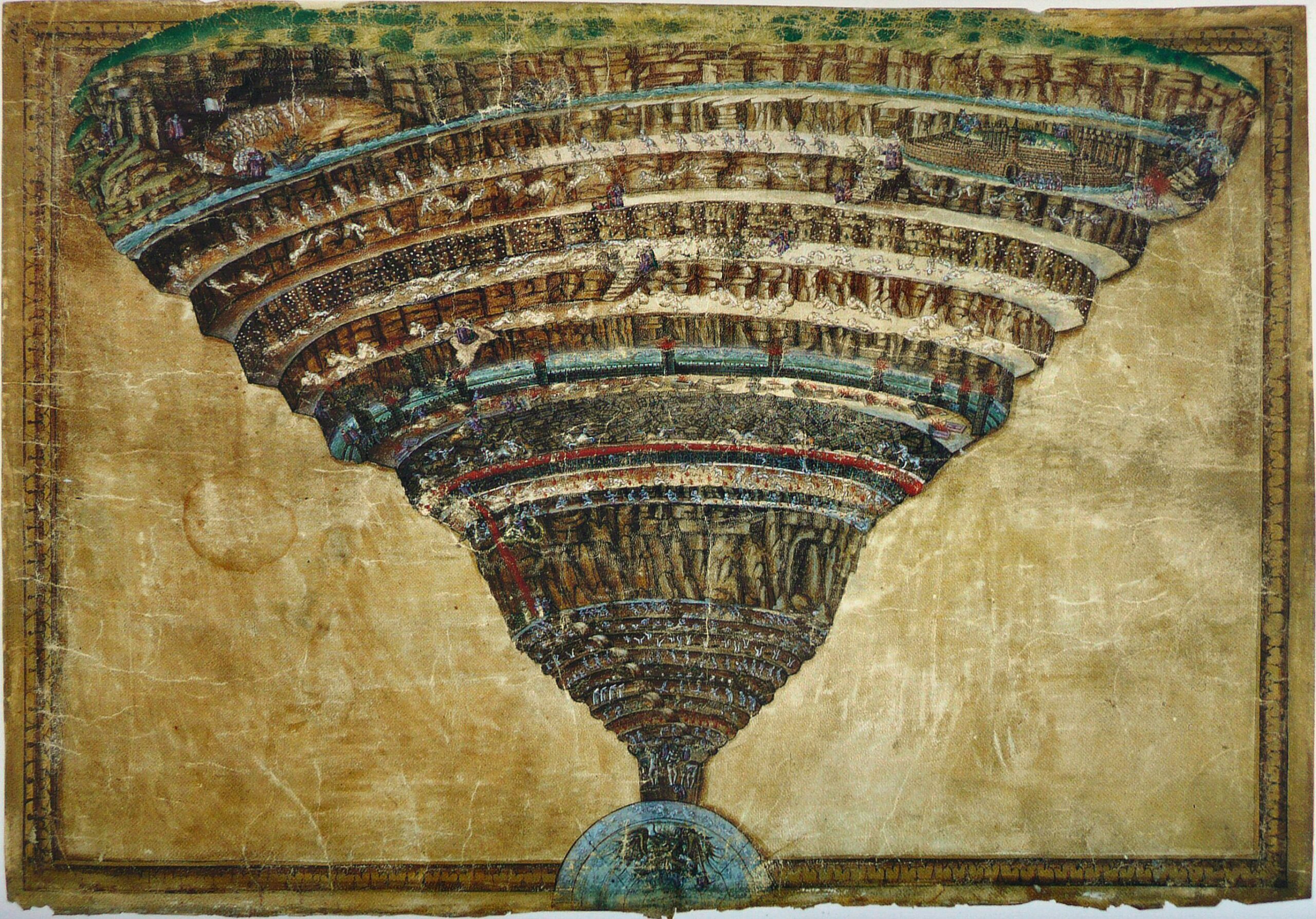
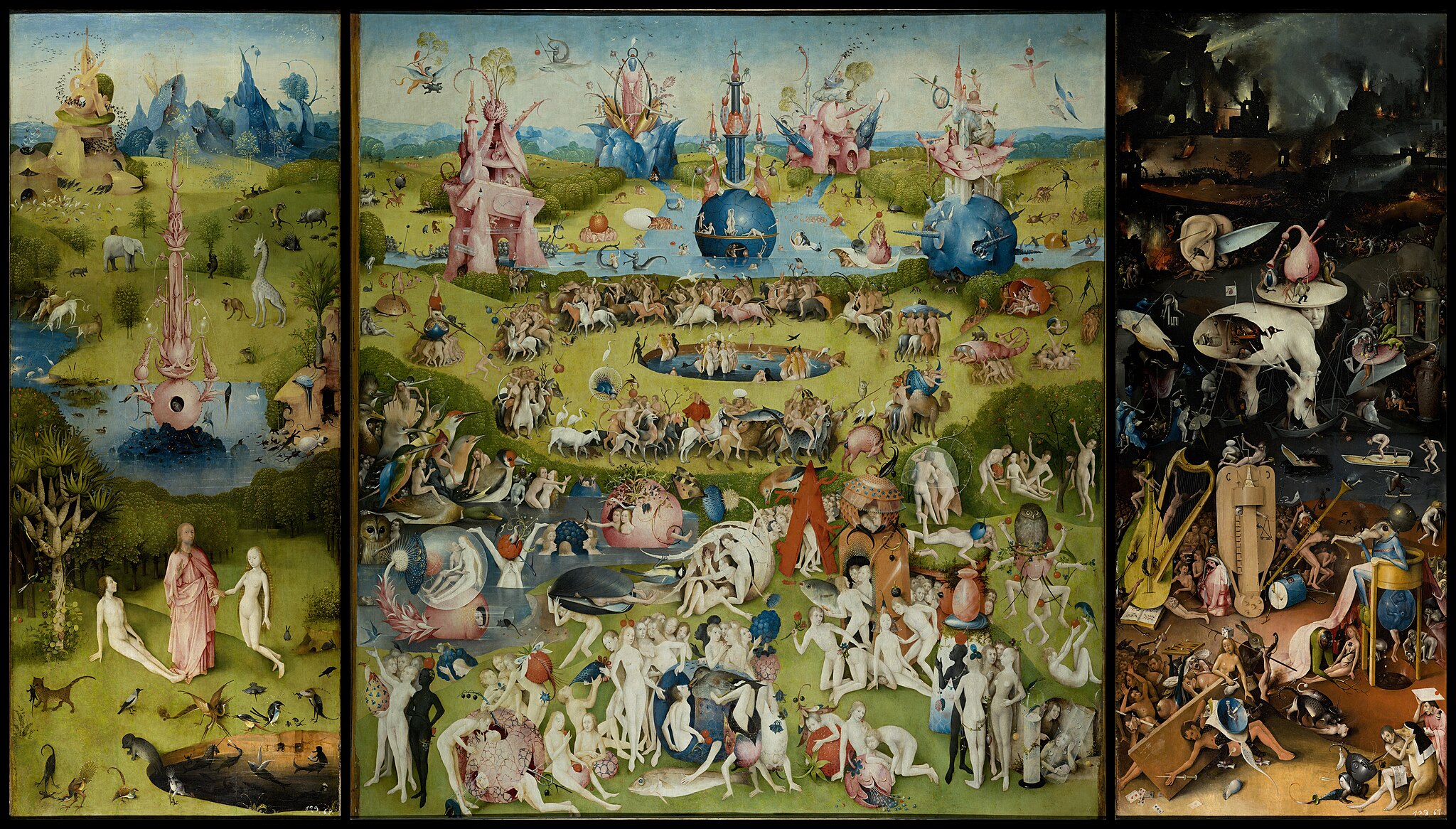
During the Middle Ages, theological reflections on hell became increasingly detailed. Thomas Aquinas , in his Summa Theologiae, argued that the torments of hell were both physical and spiritual, inflicted by separation from God and missing the beatific vision (poena damni) and direct punishment for sins (poena sensus).4Cf. Thomas Aquinas, Summa theologiae, Supplementum, Q. 97, art. 2. Aquinas also addressed the justice of eternal punishment, asserting that finite human actions could have infinite consequences when directed against an infinite God. Cultural depictions of hell flourished during this period, reflecting both theological orthodoxy and popular imagination. Dante Alighieri’s Divine Comedy (c. 1320) provided one of the most enduring portrayals of hell, envisioning it as a series of concentric circles, each corresponding to specific sins. Dante’s work, while not doctrinal, profoundly shaped Western perceptions of hell as a place of meticulous moral order and poetic justice.5Cf. Alighieri, Dante, Inferno, passim.

3.3. Modernity
The Protestant Reformation challenged traditional depictions of hell, rejecting many medieval embellishments while reaffirming its biblical basis. Martin Luther emphasised hell as the ultimate consequence of sin, but he decried its exploitation through practices like the sale of indulgences.6Cf. Luther, Martin, Ein Sermon von Ablass und Gnade (1518), WA 1, 239–246. The Reformation also marked a shift away from the dramatic visualisations of hell that characterised medieval Christian thought. Protestant theology prioritised the authority of Scripture, leading to a more restrained and text-based approach to eschatology. Yet the fear of hell remained a potent element of Protestant preaching, particularly in Puritan traditions, where it was used to inspire repentance and conversion.
3.3.1. Modern Critiques and Alternatives
From the Enlightenment onwards, the doctrine of hell has been increasingly scrutinised. Philosophers like David Hume and Immanuel Kant questioned the morality of eternal punishment, suggesting (among other things) that it was incompatible with divine benevolence.7Cf. Hume, David, Dialogues Concerning Natural Religion. Part XII (https://www.earlymoderntexts.com/assets/pdfs/hume1779.pdf), accessed on 26.08.2025, 57; Kant, Immanuel, Die Religion innerhalb der Grenzen der bloßen Vernunft, II.3. Theodical concerns also emerged, with critics asking why an omnipotent and loving God would permit eternal suffering.
These critiques spurred alternative theological models. Annihilationism, or conditional immortality, posits that the wicked are ultimately destroyed rather than subjected to eternal torment. This view, supported by biblical texts like Matthew 10:28, challenges the traditional notion of hell as eternal conscious punishment.
Universalism offers another alternative, envisioning a God whose mercy ultimately triumphs over judgment. Church Father Gregory of Nyssa is often invoked as advocate of this position.8Cf. Gregory of Nyssa, De anima et ressurectione (Gregorii Nysseni Opera 3.3), 102; Ludlow, Morwenna, Universal Salvation. Eschatology in the Thought of Gregory of Nyssa and Karl Rahner, Oxford 2000. While universalism remains controversial, it reflects a broader shift towards emphasising God’s love and restorative justice.
The “free-will defence,” articulated by C. S. Lewis , reframes hell as a state chosen by individuals who reject God.9Cf. Lewis, C. S., The Great Divorce, London 1945. This perspective aligns with libertarian accounts of free will, asserting that God respects human autonomy even when it leads to eternal separation. In this view, hell becomes less about divine retribution and more about the self-imposed consequences of human choices.
4. Systematic-Theological Positions
Hell’s theological significance extends beyond debates over its nature or duration. It serves as a lens through which Christians explore profound questions about justice, freedom, and the nature of God. Traditionalists argue that hell underscores the gravity of sin and the necessity of divine justice,10Cf. Walls, Jerry L., Hell. The Logic of Damnation, Notre Dame 1992. while critics highlight its implications for God’s character and human dignity.11Cf. Fudge, Edward William, The Fire That Consumes. A Biblical and Historical Study of the Doctrine of Final Punishment, Cambridge 2012.
Hell also intersects with broader eschatological themes, including the hope for resurrection and the final restoration of creation. Whether envisioned as a permanent realm, a temporary state, or a symbol of existential alienation, hell challenges believers to grapple with the ultimate consequences of human actions and divine purposes.
5. Conclusion
Hell remains a vital and contested concept in Christian theology. Its evolution—from the shadowy Sheol of the Hebrew Bible to the fiery Gehenna of New Testament warnings, from Augustine’s eternal punishment to modern debates about annihilationism and universalism—reflects the dynamic interplay between scripture, doctrine, and cultural imagination. As a doctrine, it continues to provoke profound theological reflection, serving as a testament to the mysteries of divine justice, mercy, and human destiny.